
What Is a Dead Letter Queue (DLQ)? Complete Guide to Message Failure Handling
Introduction
Modern applications rely heavily on distributed systems, microservices, and message queues to process data reliably. But what happens when a message fails repeatedly and cannot be processed?
This is where a Dead Letter Queue (DLQ) becomes essential.
A DLQ acts as a safety net that captures failed messages, making sure they don’t disrupt your system or get lost forever.
What Is a Dead Letter Queue (DLQ)?
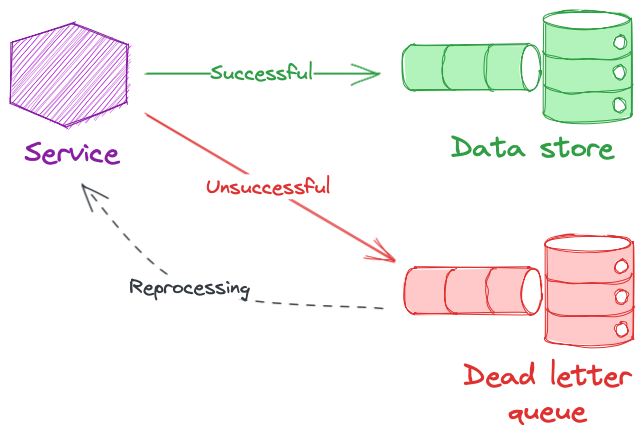
A Dead Letter Queue (DLQ) is a specialized message queue designed to store messages that cannot be processed successfully.
Instead of allowing problematic messages to continuously retry and block the system, they are moved to the DLQ for later inspection and resolution.
These failed messages are often referred to as poison messages.
Why DLQ Matters?
1. Without a DLQ:
- Messages may get stuck in infinite retry loops
- System performance can degrade
- Valid messages may get delayed or blocked
2. With a DLQ:
- Failures are isolated
- Systems remain stable
- Teams can debug issues effectively
Why Do Messages Fail?
Understanding why messages fail is essential for building reliable and resilient systems. Below are the most common reasons:
1. Bad Data
Messages often fail when the data they carry is invalid or incomplete—for example, incorrect JSON format, missing required fields, or a corrupted payload can prevent the system from parsing or processing the message properly.
2. Application Bugs
Failures can occur due to issues in the application code, such as logic errors, unhandled exceptions, or bugs that cause the message processing flow to break unexpectedly.
3. External Service Failures
Sometimes the system depends on external services like third-party APIs, databases, or other microservices, and if these dependencies are unavailable or slow, the message processing can fail.
4. Retry Limit Exceeded
If a message continues to fail even after multiple retry attempts, it eventually reaches a retry limit and is marked as a poison message, indicating it cannot be processed successfully without intervention.
When Should You Use a Dead Letter Queue?
A Dead Letter Queue (DLQ) is essential in systems where losing data or missing a message is not an option, as it helps capture and isolate failures for later recovery.
1. Financial Transactions
In financial systems, every transaction, whether it’s a payment, refund or a billing operation, must be processed accurately, as even a single failure can lead to compliance issues, financial discrepancies, and loss of customer trust.
2. E-commerce Orders
For e-commerce platforms, failed order processing can result in lost sales, incorrect inventory updates, and poor customer experience, making it critical to track and recover failed messages.
3. IoT & Monitoring Systems
In IoT and monitoring environments, missed alerts or unprocessed sensor data can lead to operational failures or safety risks, especially in industries like healthcare, manufacturing, or security.
Rule: If your system cannot tolerate silent failures or unnoticed data loss, implementing a DLQ is highly recommended.
Key Patterns for Handling Message Failures
1. Retries with Exponential Backoff
Instead of retrying instantly, increase the delay between retries:
Example Pattern:
1s → 2s → 4s → 8s
Benefits:
- Prevents overloading failing services
- Gives dependencies time to recover
- Reduces system strain
2. Isolate Poison Messages
After a predefined number of retries, move the message to the DLQ.
Benefits:
- Prevents infinite retry loops
- Keeps the main queue clean
- Ensures smooth processing of valid messages
3. Circuit Breaker Pattern
When failures exceed a threshold, stop calling the failing service temporarily.
How It Works:
- Detect repeated failures
- Open the circuit (pause requests)
- Redirect messages to DLQ
- Resume once the system recovers
Benefits:
- Prevents cascading failures
- Improves system resilience
- Protects downstream services
Conclusion
A Dead Letter Queue (DLQ) is a critical component in modern distributed systems. It ensures that failed messages are handled gracefully without impacting the overall system.
However, implementing a DLQ is just the first step. Combining it with strategies like retries, exponential backoff, and circuit breakers is what truly builds a resilient architecture.
If your system handles critical data, a DLQ is essential.